 AI
AI in Real Estate

AI already covers three distinct layers of work. A property developer gets daily market monitoring, renders and ad copy. A sales team gets an AI manager in messaging apps that answers buyers at night and calculates installment payments for a specific apartment. A broker, an agency or realtor who sells a developer's apartments for a commission, gets live prices across the whole market and a transparent client log.
Some tasks go live in the first two weeks. Others take several months. Here is what each role gets, and where to start.
Why the Tashkent market needs this now
CMWP's 2025 year-end review, published in December, shows Tashkent recorded more than 85,000 transactions, the highest since 2019. Housing completions grew 16% and exceeded 2.17 million square metres. 85% of new housing falls in the economy, comfort and comfort+ segments, priced around $1,000-1,100 per square metre. The average year-end discount was about 10%. Big market, fierce competition.
Developers compete on the monthly installment payment. A buyer compares monthly amounts; the full price fades into the background. The typical structure: 30% down, the balance spread over 24 months. Source: Majento research on public residential-complex listings, September 2026.
Own channels (website, Telegram, Instagram) could be found for only 61 of 142 active developers; the other 81 are visible to buyers only through aggregators (listing catalog sites) and agencies. Dependence on brokers is a data question. Whoever holds the client history controls the relationship. Source: Majento market map research, September 2026.
The figures come from the survey summary Majento compiled on its scenarios page. A JLL 2025 survey found that 88% of real estate investors and owners worldwide are already piloting AI, but only 5% have hit all their targets. Plenty of pilots, few results. Dodge data from 2025 shows 87% of contractors expect gains from AI and 40% have budget for it.
What AI does for a developer
The clearest entry point is market monitoring. AI collects competitor prices, promotions, and installment terms every day. Legal changes arrive unpredictably, and AI tracks those too.
Here are the numbers from Majento monitoring data on 5 October 2026. The median price (the price in the middle when all prices are lined up from lowest to highest, so a few unusually expensive or cheap units do not move it) across 47 residential complexes in the accessible $1,000-1,300 range was $1,132 per square metre. Across all 184 new-build complexes in the city the figure was $1,223. Secondary market: $1,566. Telegram channels covering new builds: $1,710. Realtor Telegram channels: $1,702. 40% of the 125 complexes with available data advertised a discount.
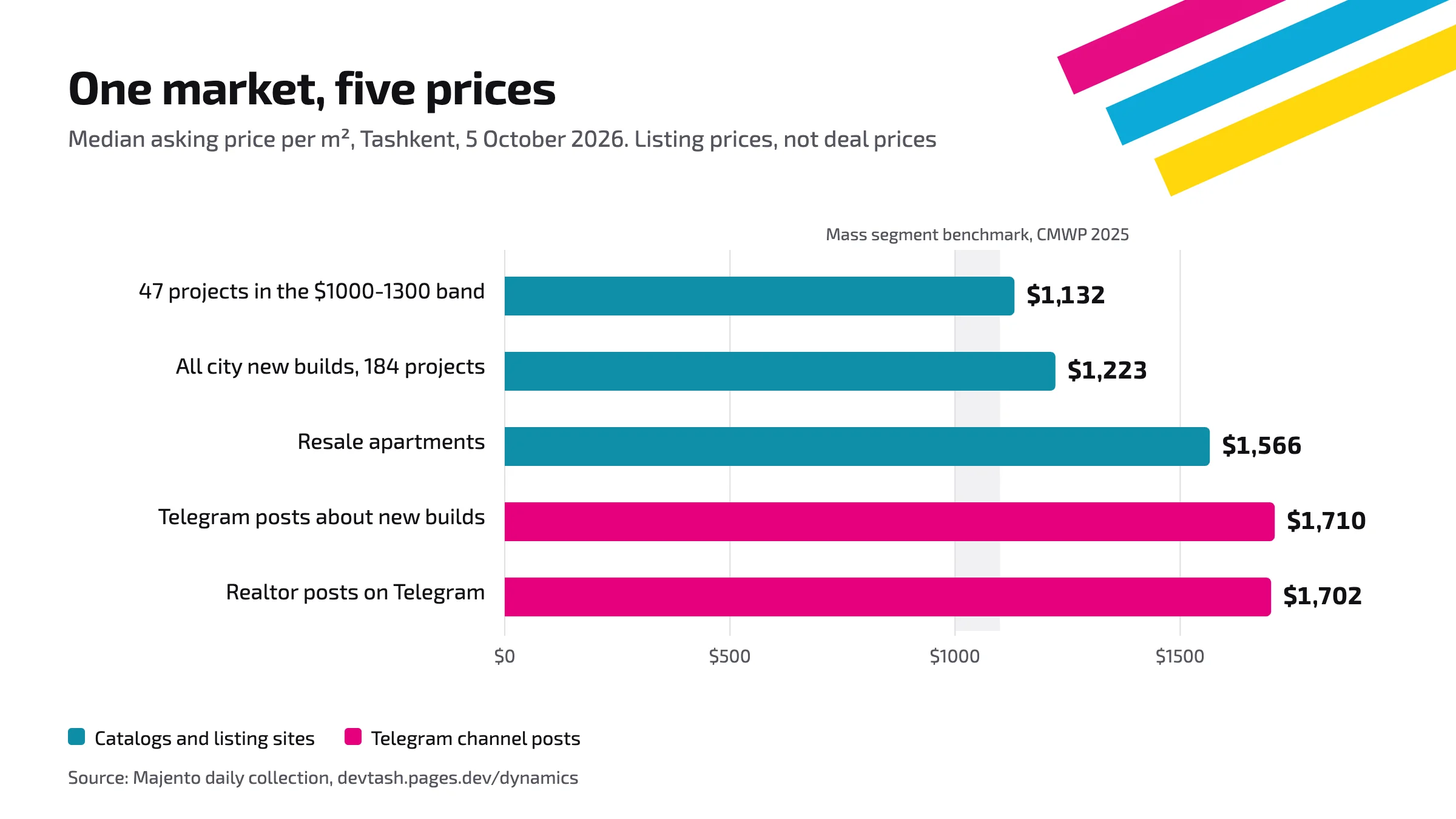
One residential complex appeared on two different sites simultaneously at $1,150 per metre and $1,015 per metre. The asking price is not the sale price. That gap is information an AI manager and a broker can use in conversation with a buyer.
Apartment mix, which floor plans and sizes to build in the next phase, is another area AI can help with. It reads the listings: which layouts and sizes nearby complexes offer, and at what price. Accuracy improves when the developer's own transaction data is added to public listings, but open listings alone already provide value.
Content and advertising also works now: renders, finish-option visuals, ad copy, monitoring competitors' ads and reviews about the company. The chain from ad to inquiry to deal can be tracked to show which advertising actually generates sales; it is set up in the first one to two months, together with the CRM connection.
Heavier tasks require connecting AI to the developer's internal systems. Construction monitoring from 360-degree photos and drone footage, foreman voice reports, cash-flow forecasting, payment reconciliation. Timeline: from a few weeks to three to six months, depending on how ready the systems are.
What AI does for a sales team
An AI manager handles buyer conversations in Telegram, Instagram, and WhatsApp, replying in seconds at any hour. It selects apartments from the unit grid, a table of every apartment in the complex organized by floor and entrance, showing whether each unit is available, reserved, or sold. It calculates the installment payment for a specific apartment: down payment, term, monthly amount. It also compares your complex with nearby ones on price and terms, drawing on monitoring data.
No lead waits until morning.
A lead is an inquiry from a buyer that includes their contact details. It arrives at 2 a.m., on a Sunday, on a holiday. While the manager sleeps, the AI clarifies the budget, offers options, and books a viewing. The manager opens their CRM (a client-tracking system) in the morning to find a ready-made contact card.

Below is a made-up example of how such a dialogue plays out in Telegram. In real work, the AI would pull the specific apartment figures from the developer's unit grid:
Buyer, 02:17: Hi, do you have two-bedroom apartments on installments?
AI manager: Hello! Yes, we do. Market monitoring puts the median new-build price across the city at $1,223 per sq m, and $1,132 in the accessible range. Installment terms: 30% down, balance over 24 months. I'll send you an exact calculation once you pick a unit from the grid. Want to see available two-bedrooms?
Buyer: Yes, and is there parking?
AI manager: Floor plans sent. Parking and storage units are available; prices depend on the specific option you choose. Shall I book a Saturday viewing?
This dialogue runs on three data sources: the developer's unit grid, the installment schedule, and monitoring data. Without them the AI starts inventing prices and terms, so the launch begins by connecting this data.
The AI upsells parking, storage, and finish options at the right moment in the conversation. It sends follow-up messages if a client toured an apartment but has not decided yet. Online booking connects together with the unit grid in the first one to two months.
On the manager's side, AI fills in the CRM card automatically and prompts the next action. A training simulator also works today: AI plays a tough buyer, negotiating hard and pushing for a discount.
Speech analytics across 100% of calls, rather than spot-listening, is a first-month-or-two task. A sales head physically cannot listen to everything. AI listens to all calls and surfaces where clients were lost, how long the gap was from inquiry to first response, and which objections come up most often.
Voice AI on calls is "soon": the tools exist, but Uzbek speech recognition needs testing on real calls before launch. Mistakes here cost clients.
What AI does for brokers, and how developers can structure that relationship
Brokers need the same tools as the sales team: up-to-date prices and installment terms across all residential complexes in the city, payment calculations for specific apartments, and client responses in messaging apps.
But brokers have a chronic pain point: who brought the client first. Without a timestamped log this is always a dispute. An AI broker portal removes the argument. Whoever registered the client first is visible in the record. Commission tracking becomes straightforward: payment goes to brokers who actually brought the clients.

From 8 November 2026 Uzbekistan's new law on real estate brokerage (ZRU-1163) takes effect, with an official realtor registry. A transparent client log and verified market data become more important for brokers.
What works now and what takes time
First two weeks: market monitoring, texts and renders, contract review. These tasks need no connection to the developer's internal systems.
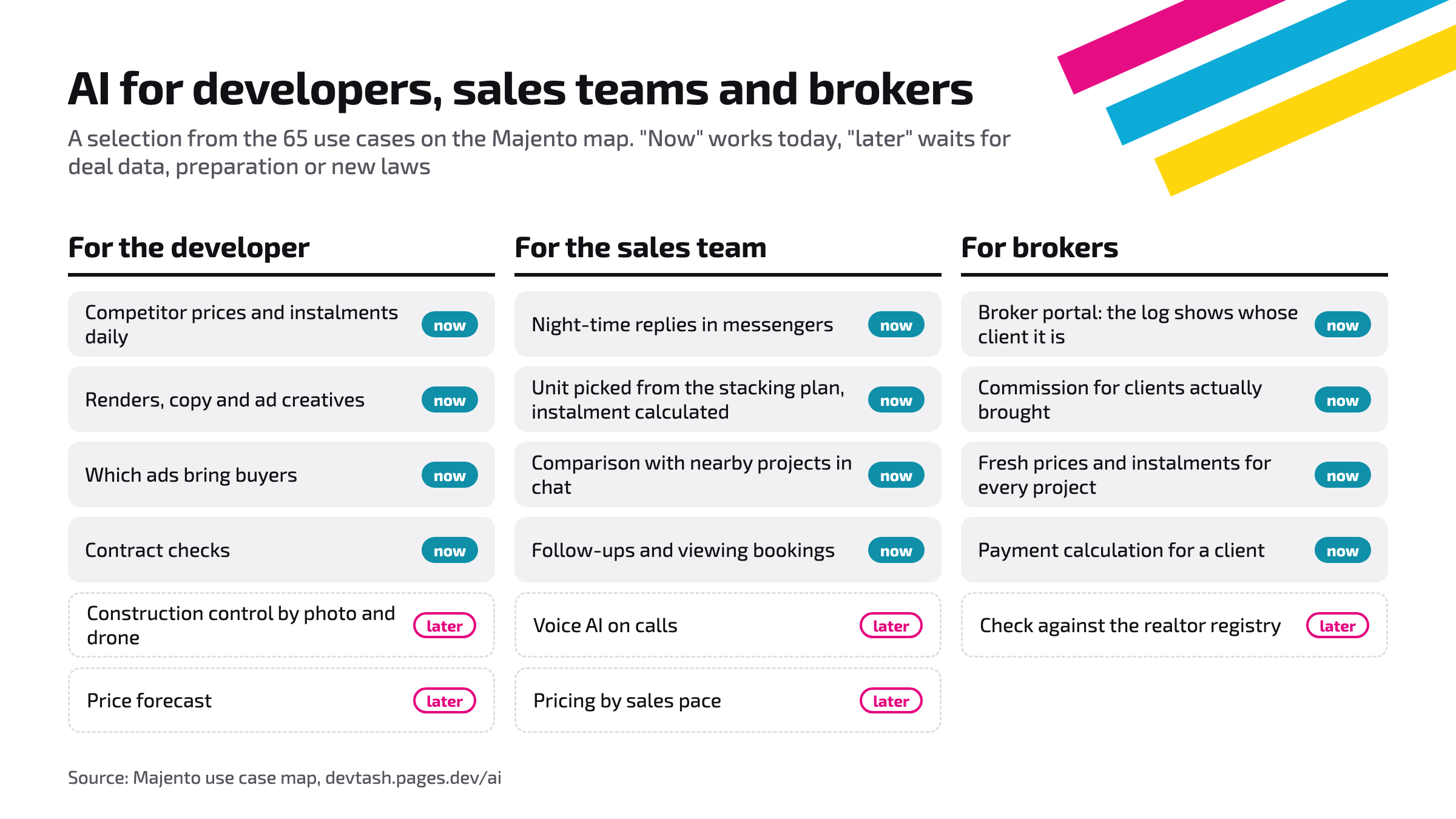
First one to two months: AI manager on top of the unit grid and CRM, advertising-to-inquiry tracking, speech analytics, broker portal. These require connecting the CRM and the unit grid to the AI.
Three to six months: construction monitoring, cash-flow forecasting, dynamic pricing, post-sale buyer support.
Price forecasting and dynamic pricing land later because they need data. A reliable sales tempo only becomes clear after 6-8 weeks of daily snapshots: an apartment that disappears from the database might have been purchased, reserved, or simply pulled from sale.
One more requirement touches the law. Uzbekistan's new personal data rules (ZRU-1125) have been in force since March 2026. AI processes buyer conversations and calls only in compliance with those rules. This is built into the project from day one.
How we tested this in the Tashkent market
Over six days, from 30 September to 5 October 2026, one person working with AI agents built: a map of 559 residential complexes in Tashkent covering 314 developers, a page listing 65 AI scenarios in real estate, and a daily market monitor that refreshes automatically every morning at 09:00.
The monitor reads listing catalogs and boards (around 2,000 apartment listings on uybor), 39 developer and aggregator websites, 94 Telegram channels, and 71 Instagram accounts. Collection follows fixed rules, no machine learning involved. It is cheap mechanical work. AI agents serve a different purpose: writing and repairing the data-collection scripts when a site changes its layout.
Every price version is stored, so you can see what changed, when, and by how much. Without price history you cannot read market direction, and you cannot tell whether a competitor's discount is genuine or whether the price was raised first.
All the work is packaged as an agent skill file, a rules file containing reference data and scripts that any AI agent uses to repeat the collection process with the single phrase "update the dynamics." The product does not depend on one person. More on this approach: AI Agent Skill from a Repeatable Task.
What comes next: market data and an AI manager instead of another CRM
Uzbekistan already has several CRM platforms built for developers. Another one is not what the market needs.
A developer needs two things in one place: market data with history and an AI manager that works in messaging apps, uses the unit grid and monitoring data, and never drops a night-time inquiry. According to Majento's review of about 40 AI sales tools for developers on the scenarios page, no such ready-made product exists in Uzbekistan; agencies build scripted bots for $800-2,500. It is what we are building next.
Frequently asked questions
Where should a developer start
Two steps in the first two weeks: launch market monitoring and start using AI for texts, renders, and contract review. No connection to your own systems required. After that, in the first month or two, an AI manager on top of the unit grid and CRM. Full details on the rollout sequence: AI Implementation in Team Processes.
Is an in-house IT department required
For the first steps, no. Market monitoring and content tasks launch without your own programmers. The AI manager in messaging apps requires connecting the unit grid and CRM. That needs technical specialists, but not necessarily full-time employees.
Will AI replace managers and brokers
No. AI removes routine work: late-night inquiries, installment calculations, filling in contact cards. Decisions stay with the manager: offering a discount, negotiating terms, closing a complex deal. A broker sells through personal contact and trust. AI is a tool in that process.
Does this work in Uzbek
Text tasks: yes. Voice scenarios: Uzbek speech recognition needs testing on real calls before launch.
How is this different from a CRM
A CRM, a client-tracking system, records who called, what they bought, and when to follow up. AI on top of a CRM does something different: it replies to clients directly, calculates installment payments, monitors competitors, and checks the quality of manager work. They are separate jobs that work together. How to prepare your team for working with AI: Training a Developer's Project Office.
Questions about AI implementation in team processes and about the Tashkent market, Telegram t.me/shimaoz or hello@majento.ai.