 AI
AI
How AI Can Find the Real Reasons Customers Are Calling

AI can sort through hundreds of calls and messages faster than any person could listen to them: recordings get transcribed into text, each contact gets mapped to a three-part frame - situation, what the customer wants, what they fear - tied to the step in your process where the root cause lives, and turned into tasks with direct quotes. But the analysis itself changes nothing. Call volume drops only when someone removes the cause.
Why "respond faster" treats the symptom
A large service company once framed the problem this way: how do we handle contacts faster? A reasonable ask. But embedded in it is an assumption that contacts will always come, and the job is just to keep up.
The better question is how to remove the cause so fewer contacts arrive.
Every customer contact is a signal that something broke - in an interface, an invoice, a notification, a staff member's knowledge, or a new app release. The operator cleans up the aftermath. The cause stays where it started.
One important problem left unfixed creates a hundred urgent ones.
What calls reveal that reports hide
One company sells equipment to business customers. Their clients have a self-service account portal with many features. The call center and sales team are seven people handling around a thousand contacts a week.
Each contact carries real work behind it: check an invoice, issue a document, loop in a colleague.
Managers can realistically listen to about five calls a day. At a thousand contacts a week, that is a few percent of the total flow. You cannot build an accurate picture from a handful of conversations a day.
In the recordings, you hear things that never appear in reports: how customers describe what happened to them in their own words, and what they actually get told in return.
The CEO of one large telecom company learned at a meeting - roughly a year and a half into the job - that a subscriber who had run out of data could not pay to top up, because the payment system itself required an internet connection. He set a deadline of December 1 to fix it. By that date, nothing had changed.
Senior leaders often do not know how the company actually works day to day. Calls and messages show them, even when the written procedures say otherwise.
How to map every contact to three questions
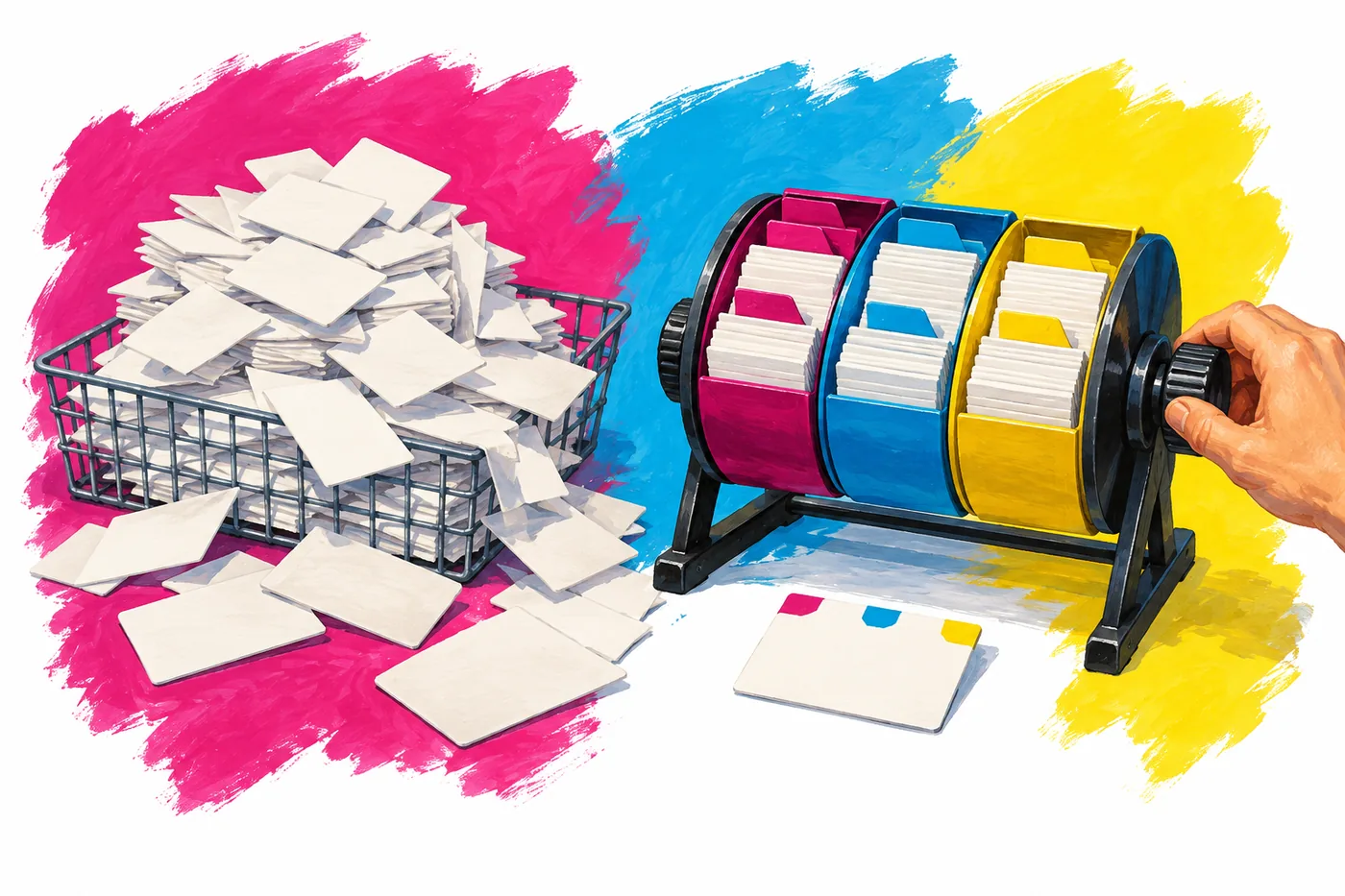
The framework is straightforward. For each contact, answer three questions: what situation brought the customer in, what do they want, and what are they afraid of. Together, those answers describe the job the customer came to get done (a concept from product theory called jobs to be done).
The customer's fear is their objection. It also points to where the process is breaking down.
AI can apply this frame to the entire volume of calls that managers never get to. For the equipment seller, it surfaced a cluster labeled "invoice problems" - about a hundred contacts a week out of a thousand. Customers in that group wanted to confirm a shipment against an invoice, clarify a delivery method, or receive their full order in one go.
A typical call: the customer asks to remove two line items from an invoice. The operator clarifies, makes the change, the customer asks when the revised invoice will arrive, and hears "five minutes."
In the self-service portal, deleting a line item should take two taps. But the invoice displays as a giant table with many buttons, and no obvious way to remove a row. The customer cannot find the right control and calls instead. The problem is in the design of the interface and the process around it.
A second breakdown in the same company starts right after an order is placed. If a customer requests additional equipment terms, no email or SMS goes out. After two or three days of silence, they call themselves.
Or they leave without ever calling.
The analysis also surfaced a phrase that managers were using repeatedly: "I'm not sure, let me check and call you back."
One call often points to several failures at once.
Six steps to run the analysis
A customer call, a chat message, and an internal task all share the same structure: a contact that moves through stages of handling. So the steps below work equally well for sales, support, and internal requests.
- Export calls and messages from the past two weeks. If contact volume is low, use a month.
- Transcribe recordings to text. This can run on the company's own servers - voice files do not need to go to third-party services.
- Tag each contact with short labels answering the three questions: what is the situation, what does the customer want, what do they fear. A single contact can get multiple tags; that is normal.
- For each tag, locate the step in the process where the cause originates: the interface, the invoice, notifications, staff knowledge, a new app release.
- Create tasks with direct quotes from calls attached, and assign one person responsible for each change.
- Once a week, count how many contacts of each type arrive per 100 orders.
Step six needs only a simple formula. Take contacts of one type in a week, divide by orders in the same week, multiply by 100. The orders figure is there so that growth in sales does not hide a problem - or exaggerate one.
A teaching example, with hypothetical numbers. Say 120 invoice-change contacts came in against 800 orders in one week - that is 15 per 100 orders. Then a clear delete button appears in the portal, and in another week the same contact type totals 34 against 850 orders, or 4 per 100. In this example, invoice contacts per 100 orders dropped by a factor of more than three.
Customer phrase - root cause - what to fix
| What the customer says | Where the cause is | What to change |
|---|---|---|
| "Remove two items from my invoice" | No obvious way to delete a row in the self-service portal | A visible delete button on invoice line items |
| "I placed an order and nobody reached out" | No email or SMS goes out for orders with additional terms | Automatic confirmation with expected timelines |
| "Can you connect me to an engineer" | Some operators route all technical questions directly to engineers | A knowledge base of engineer answers (a collected set of responses to common questions) plus a direct-connection button |
| "I'm not sure, let me check and call you back" (said by a manager) | The manager likely lacks order and invoice status during the call | Live access to order and invoice status while on the call |
| Call volume rose after new features shipped | Developers have no visibility into how their releases affect contact volume | Measure contacts after each release and share analysis results with the whole team |
The first column shows typical phrases from calls; the last column shows what to act on. Your own phrases will differ, but each one will also point to a specific place in your process.
How to check that the AI did not invent its conclusions
At scale, AI makes mistakes and sometimes fabricates - so does any human analyst. Every finding needs a path back to specific calls and quotes. This check is called cross-referencing.
If the AI reports about a hundred weekly contacts related to invoices, those calls and quotes need to sit next to the finding. A second safeguard is to link the data in advance: connect the call, the quote, and the cause before the AI touches it. Then the AI summarizes what has been prepared, rather than filling in gaps from its own inference.
How verifiable AI answers from internal documents work in practice is covered in detail in the article Verifiable AI Answers From Company Documents.
Unexpected findings also need checking. At one company, a manager asked for an analysis of calls from a period whose recordings had never been exported. The AI reported that recordings for that period did not exist, found 18,000 calls from March through July, and offered to use those instead. Before agreeing to such a substitution, check that the data falls within the access you have agreed to and may be used for this analysis.
The analysis showed that call and contact volume had grown by about 30%. Demand was not the driver: during that same period, the team had been shipping new app versions, and those releases were generating the extra contacts.
The developers had no idea. In that company, development tasks, servers, the customer management system (a database that tracks customers and their orders), and the phone system all live in separate places. Managers have no access to development systems; developers have no access to the customer system or call recordings.
Why nothing changes after the analysis

At the same equipment company, some operators responded to technical questions with: "I'm not a technical specialist, let me transfer you to an engineer." The customer lost time.
The analysis produced three hypotheses: pull those operators off technical questions; collect engineer answers into a knowledge base so a bot handles common ones; add a direct-engineer button to the self-service portal.
The design for that button had been ready for a long time. The button was never built.
The analysis saved roughly a week of manual listening work. Not a single metric moved. The department head walked away with more knowledge and a longer task list.
Call volume kept climbing. Processes and behaviors had not changed, so the numbers would not change either.
Analysis produces hypotheses. Numbers move only when someone rebuilds the process or the interface.
Tasks created from an analysis need quotes from calls attached - otherwise the person doing the work does not know exactly what to fix. AI works the same way: a vague prompt produces a vague output. How to write a brief that both a person and an AI agent (a program that carries out work steps on its own) can act on is covered in How to Brief an AI Agent on a Work Project.
Someone at the company has to own the changes: one person, a clear deadline. Without that, the analysis stays a list of hypotheses.
Majento integrates AI into company workflows and connects contact analysis to a company's existing systems with proper access controls. Details on the AI implementation and business process automation pages.
Questions and answers
How many calls do you need for a first analysis?
There is no fixed threshold. Start with an export from the past two weeks; if contact volume in that period is low, use a month.
Can you analyze recordings without sending them to third-party services?
Yes. Voice-to-text transcription can run on the company's own servers, so the recordings themselves never leave.
How is AI analysis different from a manager spot-checking calls?
A manager can realistically hear a few percent of conversations. At one company, managers listened to about five calls a day while roughly a thousand contacts arrived each week. AI applies the same frame to every call in the period, so repeating patterns surface - that is how the invoice problem cluster, about a hundred contacts a week, was found.
Who in the company should own changes after the analysis?
Whoever is responsible for the part of the process where the cause was found. If a customer cannot find a button in the portal, the task goes to whoever owns the portal. If no confirmation email goes out after an order, it goes to whoever owns customer notifications. Every change needs one owner and one deadline.
If you want to analyze your own customer contacts and find what to fix first, message us on Telegram or email hello@majento.ai.