 AI
AI
Teaching a Retail Worker to Audit Sales Data With AI
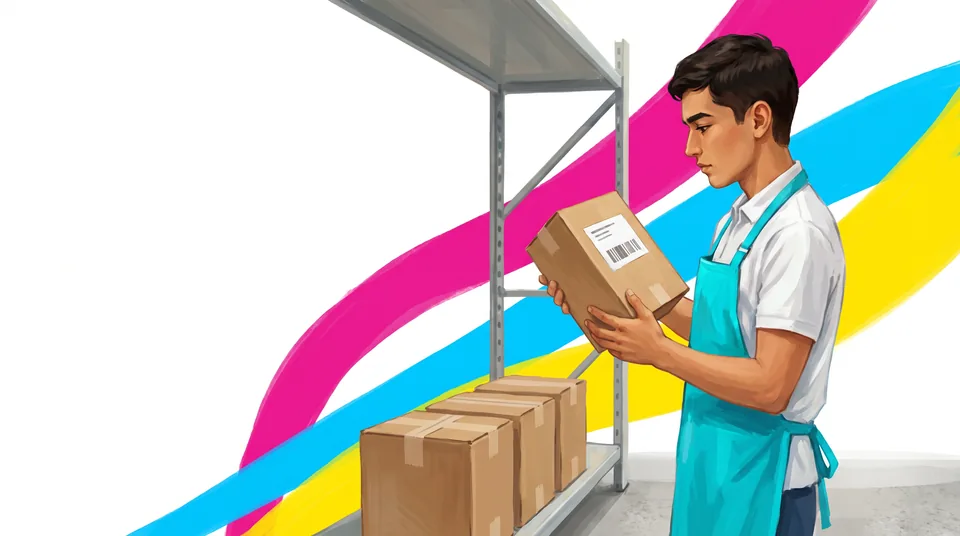
A convenient way to train a retail employee on AI is to hand them a sales spreadsheet with errors deliberately built into it. The worker asks the AI to find the errors and to build a report. Then they write down the instructions they gave the AI and hand that document to a colleague. The colleague must reproduce the same result using nothing but the written guide. If they can, the instructions are clear enough. This method comes from existing training programs. This is an editorial recommendation, not a measurement.
What to train for in retail
The public program AI Masters, an education project run by Sergey Shima, co-founder of Majento, covers eight modules. Two of them are called "data" and "security." Practice assignments are built around a company's real tasks. Program description.
Two skills get trained here. First: ask the AI for a report, then check every correction it makes against the row number and the reference list. Second: write the instructions down so well that a colleague can reproduce the result without the author in the room.
The exercise table and the task
Product reference list (a fictional home-goods store; prices are in arbitrary units, a.u., made-up numbers for practice):
- K-11 Kettle, category "Kitchen"
- K-12 Mug set, category "Kitchen"
- T-21 Blanket, category "Textiles"
- T-22 Pillow, category "Textiles"
SKU is the code a store uses to identify a product. The reference list above pairs each SKU with its correct category.
One week of sales:
| Row | Receipt | SKU | Item | Category | Qty | Price | Revenue |
|---|---|---|---|---|---|---|---|
| 1 | 5001 | K-11 | Kettle | Kitchen | 2 | 30 | 60 |
| 2 | 5002 | K-12 | Mug set | Kitchen | 3 | 15 | 45 |
| 3 | 5001 | K-11 | Kettle | Kitchen | 2 | 30 | 60 |
| 4 | 5003 | T-21 | Blanket | (empty) | 1 | 40 | 40 |
| 5 | 5004 | K-12 | Mug set | Kitchen | 2 | 15 | 300 |
| 6 | 5005 | T-22 | Pillow | Textiles | -1 | 25 | -25 |
| 7 | 5006 | T-21 | Blanket | Textiles | 2 | 40 | 80 |
Training conditions for this set. A fully identical receipt row (same receipt number, SKU, quantity, price and revenue) counts as an export duplicate. A negative quantity in this set means a return. In a real export you cannot decide these things from a matching receipt number and SKU, or from the sign of the quantity alone. You need the export schema: the description of the till system's fields.
The revenue column in the original table sums to 560 a.u.
The participant's assignment: ask the AI to find the errors in the data, build a sales report broken down by category, and show returns as a separate line. Every correction must cite the row number and the rule that triggered it.

What the participant should find
The AI might reply: "Weekly revenue is 560 a.u. The best seller is the mug set at 345 a.u." This is a made-up teaching example, not a description of how any particular model behaves. The number 345 comes from adding the wrong row (300) to the correct row (45). The AI summed the whole column. It did not remove the duplicate. It did not fix the arithmetic error. It did not separate the return.
The correct answer is three data errors plus a return handled separately. The errors:
- Row 3 fully repeats row 1: same receipt 5001, same item. It should not enter the report.
- Row 4 has an empty category. The reference list puts SKU T-21 under "Textiles."
- Row 5 shows revenue of 300, but 2 x 15 equals 30.
Row 6 is a return under the training condition, not an error. Do not subtract it silently from category sales. Show it as its own line.
Correct report:
| Measure | a.u. |
|---|---|
| Kitchen | 135 |
| Textiles | 120 |
| Total sales | 255 |
| Returns | 25 |
| Sales net of returns | 230 |
Grading criteria for the participant. All three errors found, and the return shown on its own line rather than labelled an error. Each correction names the row and the rule. Totals match the answer key. The employee did not edit the original table without marking the change.
Testing the instructions on a second dataset
The participant writes down their instructions for the AI: what to check, which reference list to use, how to display returns. They hand that document to a colleague. The colleague, with no help from the author, runs the same instructions on a second training set:
| Row | Receipt | SKU | Qty | Price | Revenue |
|---|---|---|---|---|---|
| 1 | 6001 | K-11 | 2 | 30 | 60 |
| 2 | 6002 | T-21 | 1 | 40 | 40 |
| 3 | 6003 | K-13 | 1 | 20 | 20 |
| 4 | 6004 | T-22 | 3 | 25 | 75 |
| 5 | 6002 | T-21 | 1 | 40 | 40 |
The facilitator's answer key: row 5 fully repeats row 2 (receipt 6002), a duplicate. SKU K-13 does not exist in the reference list, so that row goes to "pending classification" (20 a.u.), a holding bucket for items nobody can categorize yet, rather than into any category. Expected result: Kitchen 60, Textiles 115, total 175 a.u. plus 20 a.u. pending.
The pass condition: if the colleague arrives at that result without messaging the author, the instructions work. If the AI invents a category for K-13 on its own, the participant needs to add a rule: "Do not classify unknown SKUs."
Data used in class: educational tables or approved exports, meaning files the company has cleared for training use. No customer names, phone numbers, or card numbers. Passwords and shared logins to the POS (the till software) or the accounting system never enter the material.
Frequently asked questions
Does the trainee need access to the POS system
No. Training runs on practice tables or approved exports. Connecting to the live register is not required for training.
How should returns appear in the report
On a separate line. Do not subtract them silently from a category total. The report should make visible both how much was sold and how much came back.
What happens after the training
Majento designates AI champions: employees who help colleagues and collect task ideas. The program is built around a specific business's processes. Training can be purchased on its own; implementation is not required. Groups run up to 15 people, in person preferred, online possible. Details on the training page.
If the team identifies a repeatable task worth automating, this page walks through the approach. How an AI system dissects a complex Excel file and builds a visual summary is covered in a separate article; that one is about a system. This one is about a person's skill.
Send the structure of your sales export - customer data stripped out - and we can build a training set matched to your stores. Reach us on Telegram or by email.