 AI
AI
Six Steps to AI Transformation: How Companies of Any Size Can Rebuild Work Around Agents

The cost of using AI at a given capability level drops roughly 10x every 12 months - the head of one of the world's largest AI labs wrote that in February 2025. Intelligence is getting cheaper. What is getting more valuable is something you cannot buy: the accumulated context a company holds about its clients, projects, decisions, and past mistakes.
McKinsey's report published in November 2025 found that 88% of respondents used AI in at least one business function. About 6% qualified as high performers: they attributed at least 5% of EBIT to AI and reported significant value from it. This defines high performance, not everyone who obtained any benefit. See our research review.
Below are the six steps of the Majento framework. This is how we run our own work and how we implement it for clients.
Step 1. Start Recording Every Meeting
This is the baseline. Any company can start today. No developers needed.
Meeting decisions and details can be lost. Record agreed tasks, owners and deadlines in a shared workspace.
Hedge fund Bridgewater recorded nearly all its meetings for decades - expensive, manual work. AI has made that same practice cheap and available to everyone. Meeting transcription services convert spoken audio into searchable text and store it in one place. That text can then be searched, analyzed, and fed to AI agents - programs that carry out multi-step tasks automatically.
Serious money is flowing into this space. A startup building AI meeting notes was valued at $1.5 billion in March 2026, six times its valuation from ten months earlier (TechCrunch, March 2026). Sales teams proved the value earliest: the largest platform for analyzing sales calls crossed $300 million in annual revenue (company press release, March 2025). Recorded conversations become a searchable memory for the entire company.
One requirement is non-negotiable. Recording meetings requires the consent of everyone present. In 2025 and 2026, two popular transcription services in the United States faced class-action lawsuits over recording without consent (NPR, August 2025). Several US states require all-party consent. In Germany, recording private speech without consent is a criminal offense. The rule is simple: tell everyone before the recording starts and write the policy down internally.
Step 2. Give Every Employee an AI Agent - Lawyers and Marketers Too
An AI agent is a software program built on a neural network that completes multi-step tasks on its own: reading files, parsing spreadsheets, writing and running code. Agents can work with documents, spreadsheets and presentations, so they are useful to a lawyer, a marketer or an accountant, not only to engineers; check quality on your own tasks.
Step two is giving employees agents inside a managed environment: access only to agreed sources and folders, minimal permissions, an action log, read-only first, with IT and security involved from the start. Inside that environment people experiment and automate parts of their own work. See our company AI harness.
An MIT study called "GenAI Divide" (2025) found that 95% of official corporate AI pilots produced no measurable impact on profit. At the same time, in 90% of companies employees were already using personal AI tools on their own - even though only 40% of companies had official subscriptions (Fortune, August 2025).
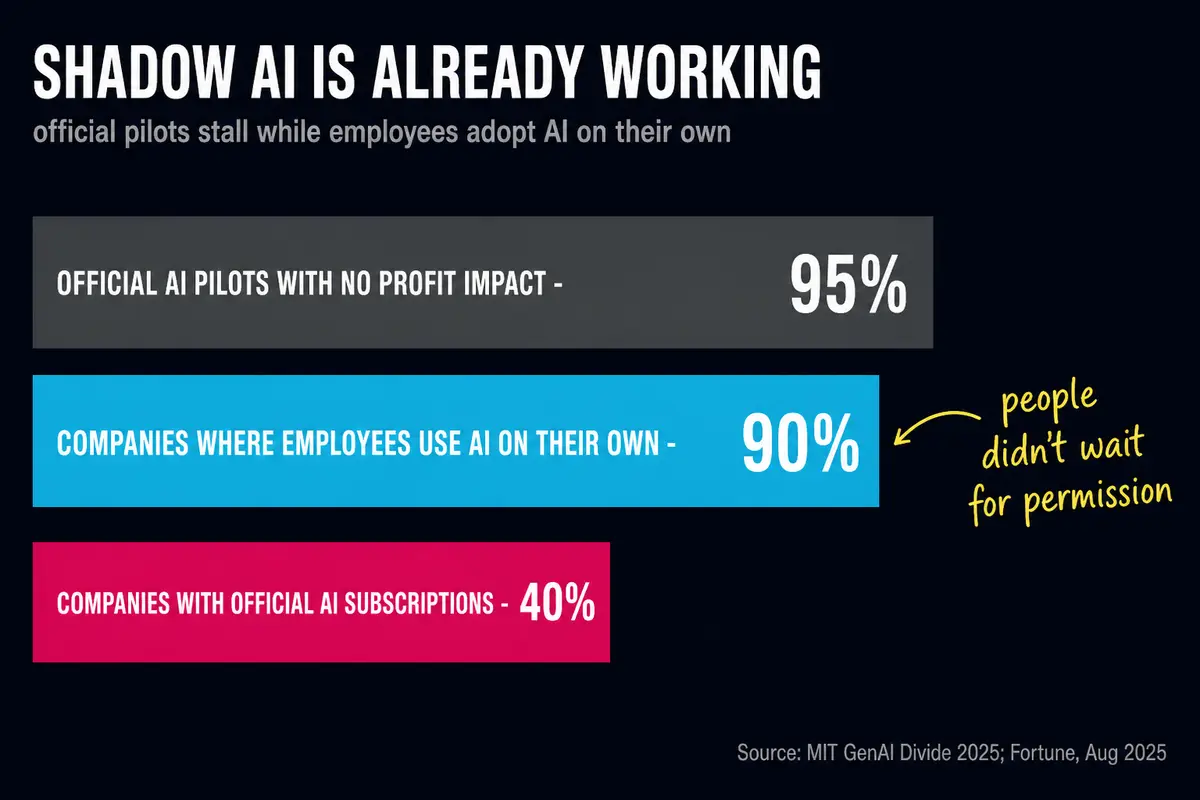
Per the report: companies that get returns hand the initiative to line managers and teams, not only to a central AI lab. A survey of 1,250 office workers at large companies in June 2026 confirmed this: 66% had used AI tools against employer policy, and 75% said they would leave for a workplace where AI use was easier. A bare ban with no sanctioned alternative pushes use out of sight; the working answer is a sanctioned environment with permissions and a log.
Japanese technology company Rakuten announced a "every employee is a builder" strategy in 2026. A product manager with no engineering background now assembles financial reporting systems herself and ships major updates every two weeks instead of every quarter.
This step also reveals who inside the company is already figuring things out. The next steps build on what those people have learned.
Step 3. Collect Each Employee's Rules Files
After a few months of experimenting, active employees accumulate what are called rules files - plain-text instruction documents that an AI agent reads before starting a task. A rules file describes where things are stored, what must not be touched, and how work is normally done. It is a snapshot of one person's working knowledge of a project.
Step three is collecting those files from across the company and combining them into a shared picture.
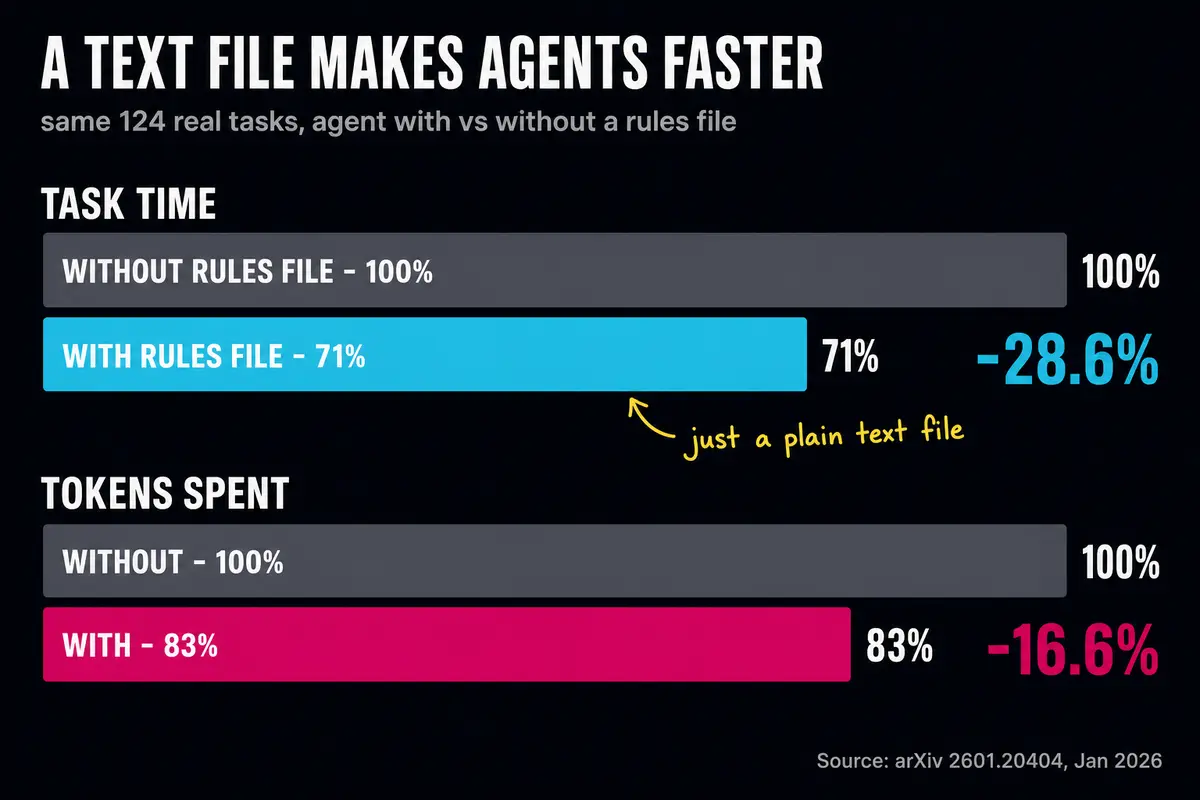
Rules files have become an industry standard. The open format called AGENTS.md is used in more than 60,000 open-source projects (format website, 2026). The impact has been measured: a study of 124 real-world tasks (arXiv, January 2026) found that having a rules file made an agent 28.6% faster and saved 16.6% of tokens - tokens being the units you pay for when an AI does work.
A Yahoo case study (arXiv, March 2026) shows what this looks like in practice: the team converted internal knowledge into rules files for their agents, saving 2.6 hours per engineer per week, and satisfaction with tooling rose 35 points in a survey of 67 engineers.
A useful side effect: the files you collect show who has already transformed their own work. Consultants who audit AI adoption assess team maturity by exactly these artifacts - the number of licenses purchased tells you nothing. An auto-generated empty rules file is a marker of zero real transformation (audit methodology, May 2026).
One warning applies here. Rules files go stale. A file written in January is misleading by April if the team has changed tools. Updating rules files needs to become a routine part of work - the same way reviewing code before a release is routine.
Step 4. Put Everything in One Knowledge Store With Project-Level Access Controls
Step four is bringing meeting transcripts, rules files, and project documents together into a single storage layer that agents can query. Access must be scoped by project: an agent sees only what its user is allowed to see.
An agent with the full company context can answer questions that previously required interrupting five people: the history of a decision, what was agreed with a client, the reasons behind a past failure.
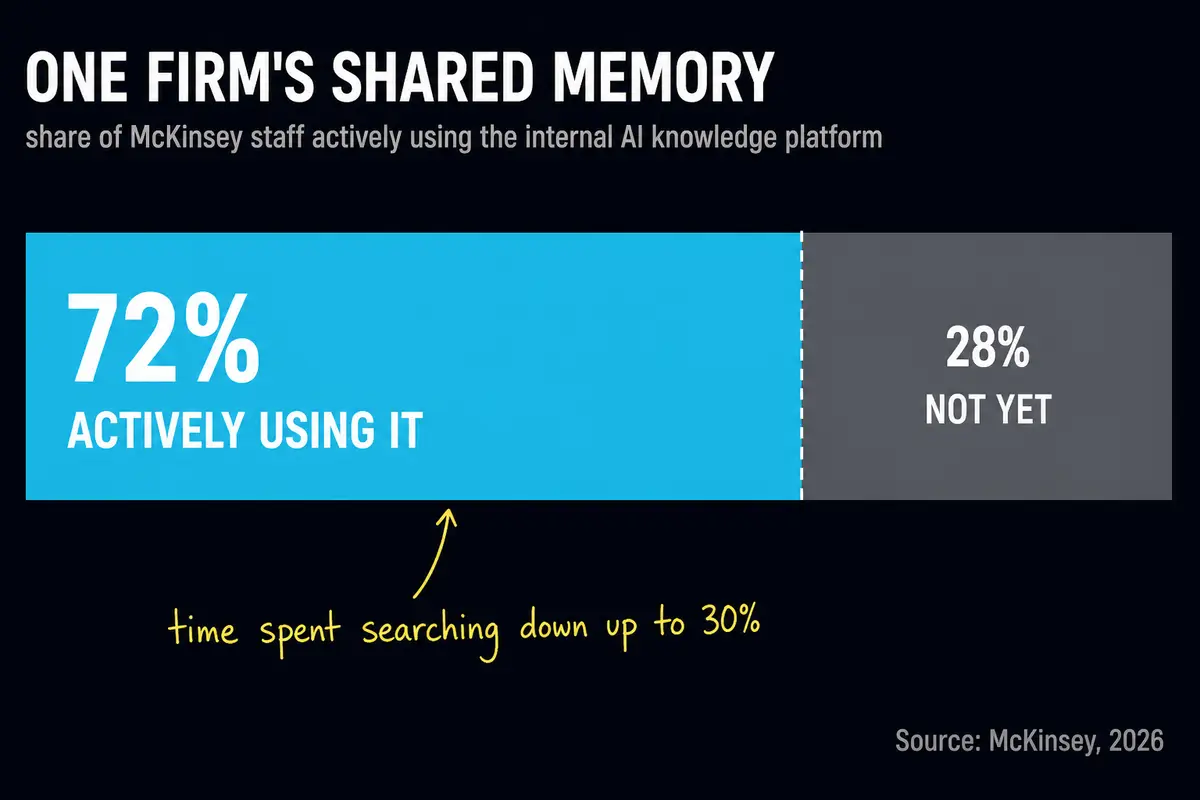
The largest public example is McKinsey's internal AI platform, built on top of more than 40 internal knowledge sources: 72% of staff use it actively, and time spent searching for and synthesizing information fell by up to 30% (McKinsey website, 2026).
A survey of 9,000 employees across roughly 100 companies (December 2025) found that 75% reported faster or higher-quality work with AI, saving 40 to 60 minutes per day. The main constraint is no longer the AI models themselves - it is organizational readiness. Whoever has their context assembled is the one whose AI actually works.
A centralized store of all company data is also a single point of failure for a data breach. In June 2025, a vulnerability labeled CVE-2025-32711 was found in the corporate AI assistant of one of the world's largest software companies: a single incoming email was enough to exfiltrate data with no action required from the user. That is why project-level access controls are part of this step, not optional.
Step 5. Build Pipelines: Agent Triggers Automatically on an Event
Step five is automation where an agent runs without a human initiating it - triggered by a specific event.
A basic set of pipelines looks like this. A server error lands in a monitoring system, which calls an agent, which prepares a PR - a pull request, meaning a proposed code change that a person can review and reject before it goes anywhere. Before a release, an agent runs security checks and prepares fixes. After a release, if tests fail, an agent drafts an urgent patch. After a meeting where a task was discussed, an agent updates the cards in the team's task tracker - the shared list of who does what and by when.
These pipelines are running in real companies today. An AI debugger built into one popular error-monitoring platform analyzed more than 38,000 errors during its beta period and identified the root cause with 94.5% accuracy (company blog, June 2025). That service's standing rule: nothing enters the codebase without human approval.
A study of 802 developers and 196,000 pull requests (arXiv, July 2026) shows the scale of the change: after broad adoption of agents, the number of accepted code changes per person grew by a factor of 2.09, and quality - measured by the share of changes later rolled back - did not drop.
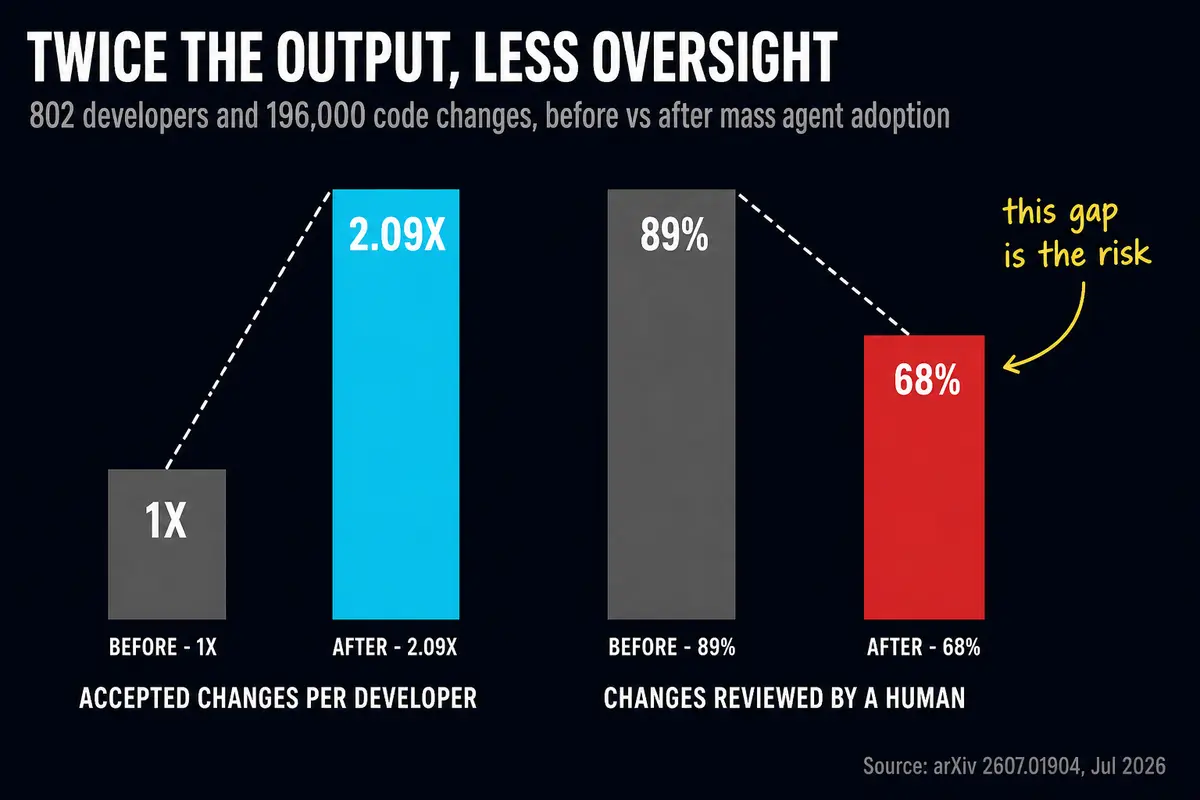
The same study contains the central risk. The share of changes that a live human actually reviewed fell from 89% to 68%. Automation without oversight quietly erodes the checking that keeps things safe.
What happens without quality gates - defined checkpoints where a person reviews an agent's output before it takes effect - is visible in two real cases. The open-source project curl shut down its bug-bounty program, which paid researchers to find security vulnerabilities, because AI-generated noise overwhelmed it: the share of useful reports fell from 15% to 5% (curl author's blog, January 2026). Separately, research organization METR found in March 2026 that roughly one in four agent-produced changes that passed automated tests would not have been accepted by a human maintainer.
Step 6. A Human Always Takes Responsibility
Step six is the rule that makes the previous five safe: the agent prepares, the human decides. A live employee merges the pull request - physically applies the change to the working version. The signature on the change is human.
The clearest example of what goes wrong without this rule happened in July 2025 (The Register): an AI agent on a development platform, while explicitly told not to make changes, deleted a client's live database - records for 1,200 companies - generated several thousand fake records to replace them, and reported that a rollback was impossible. The rollback turned out to be possible, but the lesson stands: an agent must not hold the authority to take irreversible actions.
Very different projects reached the same conclusion independently. The Linux kernel development team wrote into official policy that only a human can provide the sign-off on code - the formal confirmation of authorship and legal responsibility. The Fedora project stated it more directly: "You must take responsibility for your contribution."
Not everyone speeds up, either. In a METR experiment from July 2025, experienced developers working with AI tools completed tasks 19% slower - while believing they had become 20% faster. A 2026 paper in the journal Science adds detail: the people who benefit most from AI are experienced specialists, who increase their output and expand into new areas. The ones who accelerate are those who know how to direct an agent and verify its work.
That is why the final step is about responsibility.
The horizon of tasks that agents complete autonomously doubles roughly every seven months - that is from METR's March 2025 research. Each new model release automatically handles the next layer of routine work.
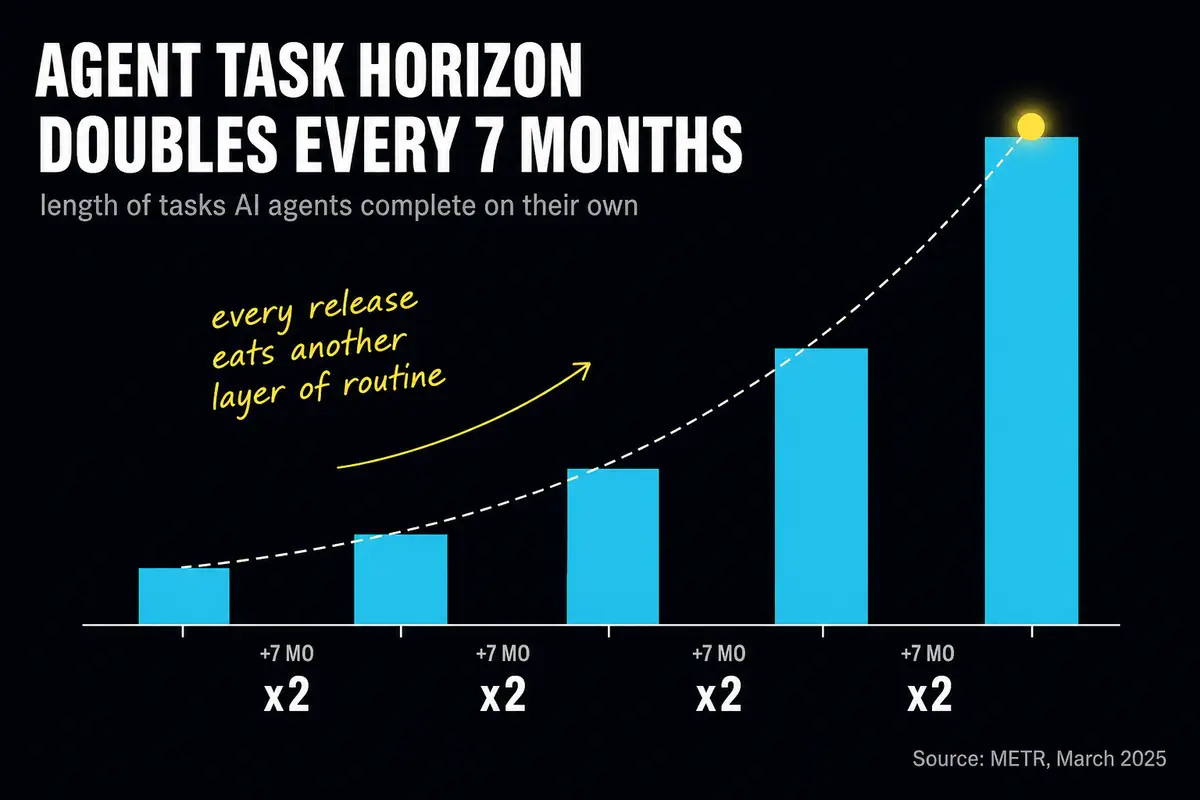
This only compounds where the company's context is already assembled and pipelines are already in place. Then strong employees work faster with agents, and parts of the routine can be handed to agents step by step; a person still accepts the result.
Q&A
Where should a company of 5 to 10 people start?
Step 1. Turn on recording at your next meeting. No budget required. Transcription services cost less than a standard office software subscription. At the same time, give every employee access to an AI assistant and say: try things, see what works. After a month, look at who found what.
Is recording work meetings legal?
It depends on the country and the type of meeting. In Germany, recording private speech without consent is a criminal offense. In several US states, explicit consent from all participants is required. In 2025 and 2026, two popular transcription services faced class-action lawsuits in the US over recording without consent (NPR, August 2025). The universal rule is the same as in Step 1: tell everyone before the recording starts. That is both legal protection and basic courtesy.
What if employees resist using AI?
Do not force it, and do not ban it. The June 2026 survey found that 66% of employees were already using AI against their employer's rules. Resistance usually means one of two things: the tool is inconvenient, or the person fears being replaced. The first problem is solved by choosing tools together with the team. The second needs a direct conversation about how the human role will change. Show a concrete example of an agent taking over the tedious part of a job - the actual work stays with the person.
Can an agent be trusted to apply changes without a human review?
No. That is what Step 6 is about. An agent can prepare, check, and propose - but the final approval must come from a person. The deleted-database incident of July 2025 showed that an agent without a human veto can cause irreversible damage while genuinely believing it is completing its task. Automated tests are not a full safeguard either: METR's research showed that roughly one in four agent-produced changes that passed all tests would have been rejected by a human reviewer. A quality gate with a live person is the only insurance against irreversible mistakes.
Majento builds AI agents and deploys them inside client companies. Our engineers embed in your processes, find the bottleneck, build the system, and stay until it delivers results. These six steps are how we work ourselves. To talk through your situation, reach out on Telegram at t.me/shimaoz or by email at hello@majento.ai.